
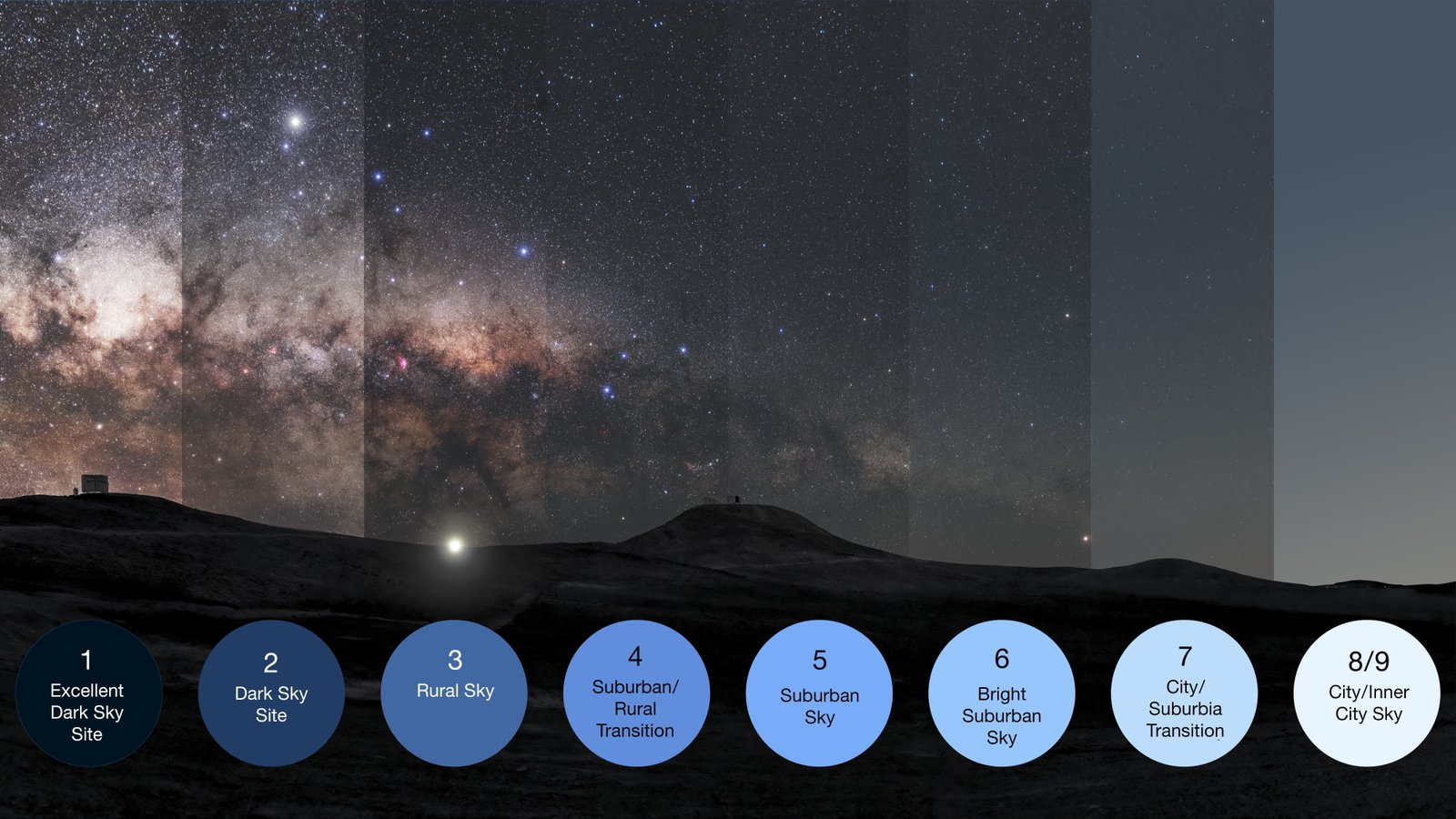
What is the Bortle Scale?
The Bortle Scale was created by amateur astronomer John E. Bortle and published in Sky & Telescope magazine in 2001. It provides a nine-level classification system for describing the darkness of the night sky.
Unlike a simple light pollution map, the Bortle Scale considers the overall observing experience, including sky brightness, visibility of stars, the Milky Way and deep-sky objects.
Understanding the ratings
Bortle 1–2
Truly dark skies
The darkest skies available. The Milky Way appears extremely bright, thousands of stars are visible and faint astronomical objects become possible to observe.
Bortle 3–4
Rural dark skies
Excellent conditions for most stargazers. The Milky Way is clearly visible and many constellations are easy to identify.
Bortle 5+
Increasing light pollution
Artificial lighting begins to reduce contrast. Brighter stars remain visible but the Milky Way becomes harder to see.
Dark skies in the UK
Much of the UK experiences significant light pollution, especially around towns and cities. The darkest locations are usually found in remote rural landscapes, national parks and recognised Dark Sky Parks.
Many of the UK's best stargazing destinations fall within the Bortle 2 to Bortle 3 range, offering some of the clearest views of the Milky Way available.
How Starnook uses the Bortle Scale
Every Starnook stay includes a darkness rating so guests can compare locations before booking.
We combine recognised measurements with practical checks including surrounding lighting, open horizons and how easily guests can enjoy the sky from the accommodation itself.