Moon · · 7 min read
Supermoons Over the UK: What to Look Out For
Every so often the full Moon turns up looking bigger and brighter than usual, and the internet lights up with talk of a "supermoon". It's one of the few celestial events you can enjoy from anywhere, no dark skies or fancy kit required. Here's what a supermoon actually is, when to catch the next ones over the UK, and one honest thing most stargazing sites won't tell you about them.
So what is a supermoon?
The Moon doesn’t orbit Earth in a perfect circle. Its path is slightly oval, so at some points it sits closer to us and at others further away. A supermoon is simply what we call a full Moon that lands near the closest point of that orbit, which makes it look roughly 14 percent bigger and about 30 percent brighter than an average full Moon.
The word itself isn’t an astronomical term at all. It was coined by the astrologer Richard Nolle back in 1979, who defined it as a new or full Moon occurring within 90% of the Moon’s closest approach to Earth. Astronomers tend to prefer the rather less catchy “perigee full Moon”, a full Moon that happens when the Moon’s centre is less than 360,000km from Earth.
The size difference is real but subtle. Side by side with an ordinary full Moon you’d notice it, but on any given night the change is gentle enough that a lot of the “wow” comes from the Moon illusion, the trick our brains play when the Moon sits low near the horizon and looks enormous next to trees and buildings.
How many supermoons happen each year?
There’s no fixed rule, and that catches a lot of people out. Because there’s no single agreed definition, the count genuinely changes from year to year.
It comes down to orbital mechanics. The Moon’s closest approach, its perigee, drifts relative to when the Moon is actually full. So in some years several full Moons line up neatly with perigee, and in others far fewer do. There are stretches, like several consecutive years in the early 2030s, where you get five in a single year.
Typically you’ll see somewhere in the range of three to four full supermoons a year under the popular definition, though four or five happen, and a stricter definition can bring the number down. The short version: don’t assume it’s the same every year. Always check the current year’s dates.
Does a supermoon affect your stargazing?
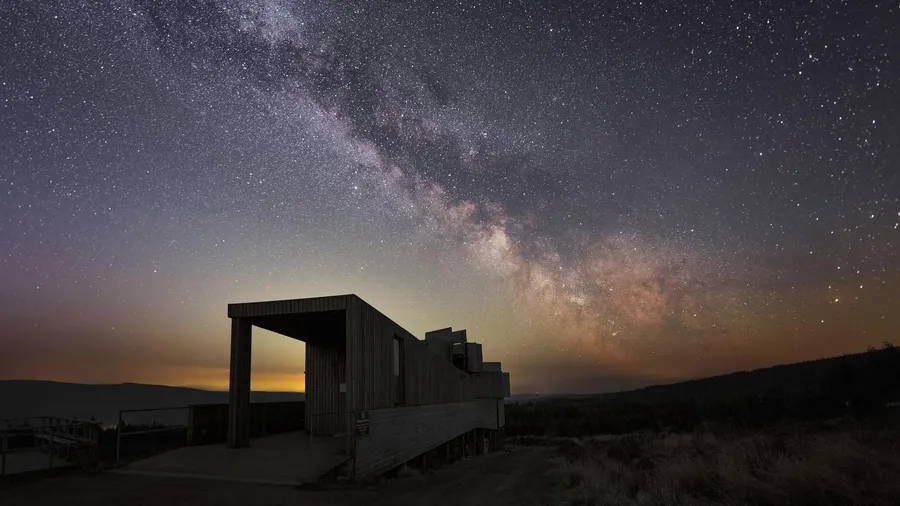
Here’s something we probably shouldn’t admit as a stargazing site: a supermoon is one of the worst nights of the month for actual stargazing. Lovely for a romantic hot tub stay, but not for spotting the Milky Way.
We know, it sounds backwards. But the two really don’t go together. A supermoon is a full Moon, which means the whole face of it is lit up and the sky is flooded with moonlight. All that brightness drowns out everything else. The Milky Way fades into the background, the faint stars vanish, and if there’s a meteor shower on, you’ll lose most of the shooting stars to the glare. The brighter and more “super” the Moon, the less you’ll see around it.
So it’s worth being honest with yourself about what you’re hoping for.
If it’s the Moon itself you’re after, that big, golden, dramatic sight that needs no equipment and doesn’t care about cloud-glow or city lights, then a supermoon night is exactly right. Wrap up, head out, catch it as it rises, and just enjoy it.
If you’re dreaming of proper dark-sky stargazing, the Milky Way stretching overhead, thousands of stars, maybe a meteor shower in full flow, then you want the opposite conditions. A night with little or no Moon in the sky, ideally around the new Moon and well away from any supermoon.
The takeaway is a simple one, and it’s the sort of thing we wish someone had told us sooner: always check the Moon before you plan a stargazing trip, not just the weather. A dark-sky spot only works its magic when the Moon isn’t stealing the show. It’s the whole reason we tell you plainly how dark the sky is above each of our stays, so you can match the night to whatever you’re hoping to see.
Tips for watching a supermoon from the UK
You don’t need any special kit. A supermoon is one of the few celestial events that shrugs off light pollution and city skies entirely. A few things that help:
- Catch it at moonrise. The Moon looks biggest and most golden just as it clears the horizon, so the illusion is working in your favour. Check local moonrise times for your postcode.
- Find a low horizon. Somewhere with a clear view to the east, a hilltop, a coastline, an open field, beats a garden hemmed in by houses.
- Bring binoculars if you have them. They won’t make the Moon “super”, but they’ll pick out craters and the dark lunar seas beautifully.
- Cross your fingers for clear skies. In a British winter, this is the real variable. Keep an eye on the forecast for a break in the cloud.
You may also see supermoons wrapped up in astrology, with talk of energy, fresh starts and heightened emotions. That’s part of the cultural appeal for many people, though it’s worth knowing there’s scant scientific evidence for supermoons having any physical effect on us or the planet. Enjoy it for what it plainly is: a bright, beautiful Moon and a good excuse to look up.
Supermoon dates this year (2026)
The first has already passed. January’s Wolf Moon on the 3rd was a supermoon, the last in a run of four stretching back into late 2025. That leaves two more to look forward to, both arriving in the run-up to Christmas:
- 24 November, the Beaver Moon. It rises in the northeast before sunset, then sets in the southwest before sunrise. This one passes close to the Pleiades and Hyades star clusters, making for a lovely observing and photography opportunity. (The name comes from the time of year trappers historically set beaver traps before the waters froze.)
- 24 December, the Cold Moon. The final supermoon of the year lands on Christmas Eve. It’s the closest and brightest of 2026, appearing around 8% larger and 16% brighter than an average full Moon. Look east as the evening goes on and you’ll find Jupiter and Mars climbing the sky, with Orion off to the southeast. (The name marks the arrival of the coldest, darkest part of winter.)
2027 supermoons (The ones that matter for viewing)
Under the popular definition, 2027 has just two full supermoons, both early in the year:
- 22 January 2027 — the Wolf Moon. This is the standout: the closest and largest full Moon of 2027, sitting right at perigee (around 357,644 km). One source gives it as roughly 7% bigger and 15% brighter than an average full Moon. It’s also the tail end of a run — the closest full supermoon of 2026 (24 December) is followed 14 lunar months later by this one, making January 2027 the last of three supermoons in a row.
- 20 February 2027 — the Snow Moon. The second and last supermoon of 2027, peaking at 23:23 UTC (11:23pm UK time), about 6% bigger and 12% brighter than average. A nice bonus for a stargazing site: it coincides with a penumbral lunar eclipse on 20–21 February — worth flagging as its own event in your calendar.
One for the stargazers: the Geminids
Here’s where the dark-sky angle pays off. Tucked neatly between those two supermoons is the Geminid meteor shower, peaking on the night of 13 to 14 December. It’s one of the best displays of the whole year, and this time the Moon is out of the way to let it shine. Under a really dark sky you might catch dozens of meteors an hour.
If you’re booking a stay for the stars rather than the Moon, this is the night we’d pick, and there’s nowhere better to watch from than a dark-sky stay in Northumberland, where the skies are among the darkest in the country.